New Writing North New Narratives Commission – Writing the Missing – A River Cycle
It’s unusual to find a competitive commission which completely matches your heart song. This was just that. And the launch of a creative body of work that is still ongoing.

My commission for New Narratives of the North East is titled Writing the Missing – A River Cycle. It is a collision of poetry, verbatim text from interviews I’ve conducted with disabled artists, lyrical essay and manifesto looking at disability arts and crip culture in the North East, how we do not take up enough cultural space, and linking this to an ambitious form based on a river cycle.
The work was presented in a variety of forms from autumn 2020, including as essays, films, podcast episodes, and as part of a special digitally-focused Durham Book Festival, before being collected in an anthology.
Writing the Missing Water Trilogy Film cycle
This was a series of three commissioned films, over three annual cycles of the Durham Book Festival. They were presented online, in person at the festival, commissioned new writing by disabled artists, and opened an invitation, in person at an event I hosted at the festival, and online for disabled artists to make connections with each other.
Director, Writer, Producer & Performer – Lisette Auton; Filmmaker, Photographer & Editor – Rob Irish; First Assistant Director and Access Support on Folding Water – Françoise Harvey; Dress design and makers on Folding Water – Lucy Hewes and Madeleine Gray; BSL Interpretation – Sue Lee at Becoming Visible
Durham Book Festival Film Commission – Writing the Missing – A River Cycle and Disability Arts Showcase
Click on the play button in the YouTube link above to watch ‘Writing the Missing – A River Cycle’
Personal, political, profound. I’m in tears, and I’m making a commitment not to give up, not to hide. I feel like you’ve given me a voice today and I suspect I’m not alone.
I was commissioned by Durham Book Festival to write, produce, direct, and perform in a film based on my New Narratives for the North East commission, ‘Writing the Missing – A River Cycle’. I also commissioned three new pieces of work in response from extraordinary North East disabled artists Bex Bowsher, Sarah Crutwell and Vici Wreford-Sinnott. Working with filmmaker, Rob Irish, we created a beautiful, startling and mesmeric lyrical dialogue with my brain, the river and the sea, in which I weave together character and setting to provoke debate and action: 25% of people in the North East are disabled, why do we not take up that cultural space?
With captions, BSL interpretation and audio description embedded from the beginning, this film shows the power of disability arts; that access is a right, a right which leads to creative freedom, innovation and wonder. The film premiered on 10th September 2020 at 5pm at Durham Book Festival.
You can read a review of the piece here.
For this piece I was awarded the Journal Culture Award 2021 for Performance of the Year.
Durham Book Festival Film Commission – Writing the Missing – All At Sea
Click on the play button in the YouTube link above to watch ‘Writing the Missing – All At Sea’
Following the success of Writing the Missing: A River Cycle, this sequel pushes the boundaries of creative access, kindness and care in a continued creative partnership with Rob Irish. Commissioned by Durham Book Festival and premiered 14th October 2021.
We’d love it if you would meet us at the waves.
Durham Book Festival Film Commission – Writing the Missing – Folding Water
Following the success of Durham Book Festival- commissioned films Writing the Missing – The River Cycle and Writing the Missing – All At Sea, Lisette Auton and Rob Irish come together for the final time in the Water Trilogy to push the creative boundaries of access, words and kindness.
Click on the play button in the YouTube link above to watch ‘Writing the Missing – Folding Water’
Across time and water, in beautiful and startling words, soundscapes and images, award-winning disabled activist, writer and performer Lisette Auton weaves together character and setting to provoke debate and action. Lisette asks why she is still folding herself into the impossible. And what would happen if she finally said no?
Content warning: this film contains a scene (at approximately 11 – 15 mins) alluding to drowning, and upsetting facts about the treatment of disabled people.
The final part in the water trilogy, bringing the story to a conclusion and an invitation into a new beginning.
Writing the Missing: the adDress
Writing the Missing: The adDress was a durational performance and installation in Middlesbrough Institute of Modern Art. It explored beauty and power within the disabled body; my missing years following illness; and acknowledged the wonder and necessity of interdependence. Part of an ongoing body of work, it askes questions of ourselves and the world around us.
Part of We Are Invisible We Are Visible (WAIWAV), presented by MIMA, DASH and funded by the Ampersand Foundation. WAIWAV marked the 102nd anniversary of the first International Dada Fair in Berlin. On 2 July 2022 31 d/Deaf, Disabled and Neurodivergent artists simultaneously staged Dada inspired interventions in 30 museums and galleries across the UK.
Credits:
Artist & Director: Lisette Auton
Photographer: Kev Howard. All photos copyright. No usage without his permission.
Dress Consultant & Maker: Lucy Hewes
Dress Design & Maker, Access Support, Performer: Madeleine Gray
Graphic Design: Joanna Deans
Organisations: Middlesbrough Institute of Modern Art & DASH
There was an installation, like a room of a house. It was on the ground floor when you entered the space. Gallery Assistants were there to help. If you liked, you could take a book and an origami handout. You could make some stars. You could make these alone or sit at the table and make them with me. You could write your missings in books. You did not have to interact, you could watch from afar or close up. There were be no loud noises or surprises. My sister helped me to put on an origami dress. Sometimes I had a nap. Sometimes I walked around. There was a sofa to sit on if you liked, or other seats at tables further away. It was a protest that was beautiful, quiet gentle and restful.
There was an audio loop playing of a conversation between my sister, me, and my nephew. You can read the transcript here.
There was an incredible information sheet about the event which was printed and designed so it could be folded into an origami pass-a-note. You can look at the Writing the Missing origami pass-a-note handout here.
There was an incredible article in the Guardian newspaper that you can read here.
How to take part in Writing the Missing – from near or far
Please join in by writing your missing on a slip of paper and folding it into a star – this short film will teach you how. Gift the star, keep the star, hide the star. Our missings are inside, but can only be seen if the star is destroyed.
Please tell me your missings so that I can catalogue them in my Catalogues of Missings and keep them safe, and then I will turn them into stars.
Little Cog Staging Our Futures Commission – Writing/Righting the Missing
In July 2020 I was awarded one of three Staging Our Futures commissions by disabled led theatre company Little Cog and funded by Arts Council England.
You can read the announcement of the commission here.
Little Cog Staging Our Futures commissions are aimed at disabled theatre makers who are pushing boundaries, questioning the world we live in and delivering powerful performance work. We want to support vibrant and pioneering artists who make work that provokes, excites and engages audiences.
I used the paid time and space to R&D (research and develop) a new piece of theatre, write an essay about ‘Who is it for?’, to create a disability toolkit, and make a short film.
Disconsortia Commission – Project Fear & Evolution – a strand of Writing the Missing

I was awarded a commission by Disconsortia for Project Fear and Evolution – a strand of Writing the Missing. To research and develop the beginnings of a workshop, or a ‘something’ which can provide a tool kit/space for others to safely and bravely fail.
The Why
All of the work that I do, write, make and create seeks to make the invisible visible. As a disabled person I have felt like a missing, I still often feel like a missing, I don’t want anyone else to feel the same. I want there to be access to all projects for everyone. Being able to choose to join in is a fundamental human right, and as practitioners it pushes us to think creatively and make truly exceptional work.
I want access for all people to be able to find themselves represented. That’s where validation and acceptance begins, that’s where we can be role models and say that the arts welcomes you. That’s where Writing the Missing began for me. Where was I in books, on the radio, on TV in films? And if I was there I was a prop-up to the protagonist, a pity, a villain, a sob story or an inspiration. Where are all the disabled stories? Where are all the disabled writers?
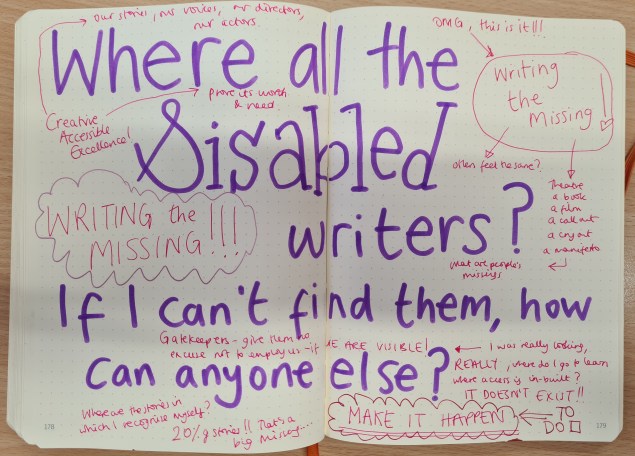
This project began in 2017, though it wasn’t until 2018 that I discovered its name. It has been a research and development project lasting 6 years and counting; self-funded and building on work through paid commissions (some of which you can find out about above), discovering the support that disabled writers need to excel, and undergoing a creative leadership programme with the SSE. Writing the Missing ties all of the strands of my practice together; it’s how I’ve realised I make sense of myself as an artist, how I make sense of my work and the work that I want to do for and with my community. The work that must be done.
Action. Not talk.
So many tick box programmes and at the end of it the door softly closes once more, and the next round opens up for new, fresh, talent. The only way this changes is by showing what we can do, supporting work being made, mentoring with access in-built from the start, and showcasing the incredible talent. Making it impossible to ignore. Making it on our terms. Then sharing this best practice. We don’t have to come to you, you will need and want to come to us.
Action. Not talk.
Where are our stories? Where are all the other disabled writers? Where is the place that holds us together, provides a beacon of creative accessible excellence, provides support, provides networking and development opportunities, provides a space where we can be found and spotlighted by and for the industry, generates new industry leaders, stops the excuse ‘I would have used a disabled writer, but I didn’t know how to find one’.
These are the questions I ask myself, that I talk about with other disabled writers when I eventually find them. With disabled people who do not know that they are allowed to call themselves writers. With disabled writers who do not have a space in which to develop their talents, without having to fight for access.
Action. Not talk.
 Lisette Auton Does Stuff With Words